
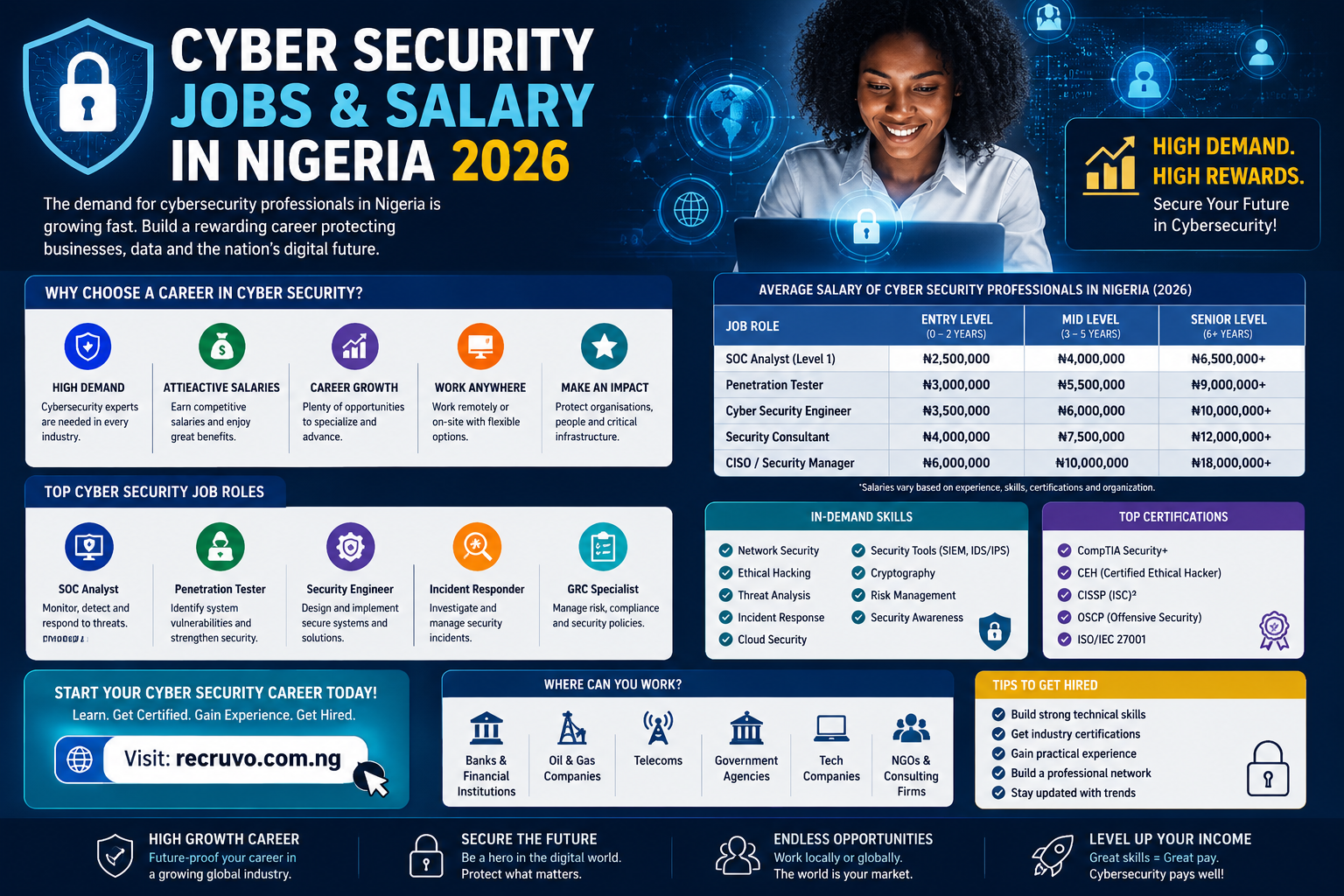
Nigeria’s cybersecurity market is booming. The country’s digital economy is on a trajectory to reach $18.3 billion, and the ICT sector’s contribution to real GDP has climbed to nearly 20 percent, making digital infrastructure protection an economic imperative rather than simply a compliance obligation. Nigeria’s cybersecurity market is growing at an annual rate of approximately 10.7%, driven by the rapid digitisation of banking, telecoms, healthcare, and government services.
Despite this explosive demand, the talent gap is severe. Industry estimates suggest that fewer than 3,000 Nigerian professionals currently meet the qualification standards required for the more than 25,000 cybersecurity roles expected across the economy by 2026.
This supply-demand imbalance directly translates into strong salaries, fast career progression, and significant negotiating power for skilled cybersecurity professionals, a dynamic that is expected to persist for years.
The regulatory environment has also intensified hiring pressure. The Central Bank of Nigeria’s Risk-Based Cybersecurity Framework mandates that all deposit money banks maintain dedicated security operations functions. The Nigeria Data Protection Act (NDPA) 2023 requires data processors and controllers to implement cybersecurity controls.
The CBN cybersecurity levy guidance issued in 2024 further reinforced the strategic importance of cyber resilience in the financial sector. These regulatory mandates have turned cybersecurity hiring from optional to obligatory for any institution operating in Nigeria’s regulated industries.
Cybersecurity Salary in Nigeria 2026: By Experience Level
Compensation in cybersecurity varies significantly based on experience, certifications, industry, and employer size. Here is the full breakdown by career stage:
Entry-Level Cybersecurity Professionals (0–2 Years)
Entry-level cybersecurity roles in Nigeria typically pay between ₦80,000 and ₦300,000 per month. The lower end of this range, around ₦80,000 to ₦120,000, is found primarily in smaller organisations and companies that do not prioritise security spending. However, entry-level candidates who arrive with relevant certifications such as CompTIA Security+ or CEH and can demonstrate practical skills through labs and platforms consistently land roles paying ₦150,000 to ₦280,000 per month at fintech firms, banks, and technology companies from day one.
The most common entry point is a Tier 1 SOC (Security Operations Centre) Analyst role, where professionals monitor network traffic, manage SIEM (Security Information and Event Management) tools, detect incidents, and escalate threats. A SOC Analyst at entry level in Nigeria earns ₦150,000 to ₦350,000 monthly, depending on the institution.
Mid-Level Cybersecurity Professionals (2–5 Years)
Mid-level professionals, typically working as Security Analysts, Penetration Testers, Incident Responders, or Cloud Security Engineers, earn between ₦300,000 and ₦800,000 per month. At this stage, specialisation becomes a powerful salary multiplier. Professionals who have developed expertise in penetration testing, cloud security, or threat intelligence command higher premiums than generalist analysts.
SOC Analysts and ethical hackers at mid-level in Nigeria typically earn between ₦400,000 and ₦800,000 monthly, particularly in the banking, fintech, and telecoms sectors where security demands are most acute.
Senior Cybersecurity Professionals (5–10 Years)
Senior professionals, including Security Architects, Security Engineers, GRC (Governance, Risk and Compliance) Managers, and Cybersecurity Consultants, earn between ₦800,000 and ₦1,500,000+ per month. At this level, the combination of deep technical expertise, leadership experience, and regulatory knowledge pushes compensation well beyond what most other technology roles in Nigeria command.
Professionals holding the CISSP (Certified Information Systems Security Professional) certification are in an entirely different salary tier. Nigerian cybersecurity professionals with CISSP frequently earn ₦1,000,000+ monthly in senior local roles and can access remote international positions paying $60,000 to $100,000 annually, a life-changing income level for a Nigeria-based professional.
Executive Cybersecurity Roles (10+ Years)
Chief Information Security Officers (CISOs), Head of Cybersecurity, and Director-level roles at large Nigerian organisations and multinationals command monthly salaries ranging from ₦1,000,000 to over ₦3,000,000. CISO roles at top-tier banks in Nigeria have been reported at ₦2,000,000+ per month, plus bonuses and executive benefits. The annual cybersecurity salary range for senior positions in Nigeria has been estimated at between ₦14,165,000 and ₦22,520,000 per year, depending on the institution and role scope.
Cybersecurity Salary in Nigeria 2026: By Job Role
Different cybersecurity specialisations carry distinct salary levels in the Nigerian market. Here is a role-by-role salary breakdown:
- SOC Analyst (Tier 1–2): ₦150,000 – ₦350,000/month (Entry); ₦400,000 – ₦600,000/month (Mid)
- Penetration Tester / Ethical Hacker: ₦400,000 – ₦800,000/month
- Cybersecurity Analyst: ₦300,000 – ₦700,000/month (average ₦508,000)
- Cloud Security Engineer: ₦500,000 – ₦1,000,000/month
- GRC Analyst (Governance, Risk & Compliance): ₦300,000 – ₦800,000/month
- Security Architect: ₦800,000 – ₦1,500,000/month
- Cybersecurity Manager / Consultant: ₦1,000,000 – ₦2,000,000/month
- Chief Information Security Officer (CISO): ₦1,500,000 – ₦3,000,000+/month
- Cybersecurity Engineer (average): ₦2,800,000+ annually, with top performers reaching ₦5,000,000
Cybersecurity Salary in Nigeria 2026: By Industry
The sector you work in is one of the biggest determinants of your cybersecurity salary in Nigeria. Here is how different industries compare:
Banking and Financial Services
Nigerian banks are the single largest employer of cybersecurity professionals in the country. The CBN’s Risk-Based Cybersecurity Framework mandates that all deposit money banks maintain dedicated security operations functions, creating sustained and predictable hiring demand. Tier-1 and Tier-2 banks run 24/7 Security Operations Centres in Lagos and Abuja, with round-the-clock staffing requirements. Banking sector cybersecurity salaries are among the highest in Nigeria, with senior roles at top banks regularly exceeding ₦1,000,000 per month.
Fintech
The fintech sector, including companies like Flutterwave, Paystack, Kuda Bank, PiggyVest, and Moniepoint, offers some of the most competitive cybersecurity compensation in Nigeria, particularly for cloud security engineers, application security engineers, and fraud analysts. Remote and hybrid work arrangements are more common here than in traditional banking, adding to the overall package value.
Telecommunications
MTN Nigeria and Airtel Nigeria both operate large internal cybersecurity teams and contract with managed security service providers. Telecoms cybersecurity roles focus on network security, subscriber data protection, and regulatory compliance, with salaries that are competitive with banking at senior levels.
Oil and Gas
Multinational energy companies operating in Nigeria, including Shell, Chevron, and TotalEnergies, invest heavily in operational technology (OT) security and industrial control systems (ICS) protection. Cybersecurity professionals with OT security expertise command a significant premium in this sector.
Government and Public Sector
Federal and state government agencies, defence institutions, and national security bodies hire cybersecurity professionals, particularly for roles involving national infrastructure protection. Salaries in the public sector are lower than private sector equivalents, but roles often come with job security, clearance opportunities, and pension benefits.
Top Hiring Companies for Cybersecurity Jobs in Nigeria 2026
The companies and organisations most actively recruiting cybersecurity talent in Nigeria in 2026 include:
- Banks: GTBank, Access Bank, Zenith Bank, Stanbic IBTC, First Bank, UBA, Wema Bank
- Telecoms: MTN Nigeria, Airtel Nigeria, Ericsson Nigeria
- Consulting and Advisory: PwC Nigeria, Deloitte, KPMG, Phillips Consulting
- Cybersecurity-Specific Firms: Digital Encode Limited, CyberDome (a leading Managed Security Services Provider operating 24/7 SOC, MDR, and red team services), SHELT Global Ltd, CyberSOC Africa, Ethnos Cyber Ltd
- Oil and Gas: Shell Nigeria, Chevron Nigeria, TotalEnergies EP Nigeria
- Technology: Interswitch, Flutterwave, Paystack, Moniepoint
Lagos and Abuja are the primary hubs for cybersecurity employment, with the vast majority of roles concentrated in these two cities. Port Harcourt is a growing market, particularly for oil-and-gas-aligned cybersecurity roles.
Most In-Demand Cybersecurity Skills and Certifications in Nigeria 2026
Technical skills determine whether you get shortlisted. Certifications determine whether you get hired, and how much you are paid. Here are the most valued qualifications in Nigeria’s cybersecurity market in 2026:
CompTIA Security+
Security+ is the most widely recognised entry-level certification among Nigerian cybersecurity employers. It has the highest hard-requirement rate of any major certification globally, appearing in a significant proportion of entry and mid-level job listings. Nigerian fintech and banking recruiters specifically mention it, and candidates with Security+ consistently earn more than uncertified peers at the same experience level. If you are entering cybersecurity with no prior certification, this is where you start.
Certified Ethical Hacker (CEH)
CEH is highly respected in Nigeria’s banking and fintech sectors, covering penetration testing concepts and offensive security methodology. It carries strong brand recognition among local hiring managers and appears frequently in Nigerian cybersecurity job descriptions for analyst and penetration testing roles.
CISSP (Certified Information Systems Security Professional)
CISSP is the gold standard globally and in Nigeria. It is the most requested certification in cybersecurity job postings worldwide, and Nigerian professionals who hold it enter a completely different salary tier. CISSP requires five years of paid work experience in at least two of the eight security domains, making it a mid-to-senior career credential. Nigerian professionals with CISSP regularly earn ₦1,000,000+ monthly in local senior roles and are well-positioned for remote roles with US, UK, and EU employers paying $60,000 to $100,000 annually.
CISM (Certified Information Security Manager)
CISM from ISACA is the certification of choice for professionals moving into management and leadership. It is particularly valuable for GRC roles and for candidates targeting cybersecurity manager or CISO career pathways. CISM requires five years of information security work experience, with at least three in security management.
OSCP (Offensive Security Certified Professional)
OSCP is the most rigorous and respected certification for penetration testers, globally and in Nigeria. It involves a gruelling 24-hour practical exam and signals deep, hands-on offensive security skills. Nigerian professionals with OSCP command premium rates both locally and in the international remote job market.
CEH, CISA, and Cloud Security Credentials
CISA (Certified Information Systems Auditor) is prominent for GRC and audit-focused roles, while AWS Security Specialty and Microsoft Azure Security Engineer credentials are increasingly valued as Nigerian enterprises migrate workloads to the cloud. Cloud security expertise carries a salary premium of up to 25% over equivalent non-cloud roles in some markets.
Key Skills Nigerian Cybersecurity Employers Look For
Beyond certifications, Nigerian cybersecurity employers consistently prioritise candidates who demonstrate proficiency in the following technical areas:
- Network security fundamentals and firewall management
- SIEM tools, particularly Splunk, IBM QRadar, and Microsoft Sentinel
- Vulnerability assessment tools including Nessus and Qualys
- Penetration testing frameworks including Metasploit and Burp Suite
- Network traffic analysis using Wireshark
- Incident response and digital forensics
- Cloud security (AWS, Azure, Google Cloud)
- Knowledge of CBN Cybersecurity Framework, NDPR/NDPA 2023, PCI-DSS, and ISO 27001
- Threat intelligence analysis and threat hunting
Increasingly, Nigerian CISOs also value communication skills — specifically the ability to translate complex threat intelligence into plain language for board and executive audiences. Cybersecurity professionals who can bridge the gap between technical operations and business strategy are especially sought after and typically command higher compensation.
Remote Cybersecurity Jobs: Earning in Dollars from Nigeria
One of the most significant income opportunities for Nigerian cybersecurity professionals in 2026 is the ability to work remotely for US, UK, and European employers while based in Nigeria. Experienced professionals with CISSP, OSCP, or cloud security credentials and at least five years of experience are increasingly landing remote roles paying $60,000 to $100,000 annually, income that positions them firmly in Nigeria’s top earning tier.
Many cybersecurity roles, particularly security engineering, threat intelligence, and GRC positions, can be performed entirely remotely. Platforms like LinkedIn, Glassdoor, and specialist security job boards list international remote roles that are open to Nigerian professionals. Building a strong GitHub portfolio, contributing to open-source security projects, and maintaining an active presence on professional security communities significantly improves your visibility to international recruiters.
How to Start and Grow a Cybersecurity Career in Nigeria
Whether you are a fresh computer science graduate, an IT professional looking to pivot, or a non-technical professional exploring a career change, the path into cybersecurity in Nigeria follows a recognisable trajectory:
Build foundational skills early. Platforms like TryHackMe and Hack The Box are accessible from a mobile phone or a café, anywhere with a reasonable internet connection. Students who start building practical security skills during university arrive at graduation with a portfolio that separates them from the competition immediately. Do not wait until after NYSC to begin.
Start with CompTIA Security+. It is the most widely recognised entry-level credential and the fastest route to a first paid cybersecurity role. Pass this first, then layer in CEH, CISM, or cloud credentials based on your chosen specialisation path.
Target SOC analyst roles as your first position. Entry-level SOC work at a bank, fintech, or managed security services provider gives you exposure to real incidents, live SIEM environments, and the regulatory context unique to Nigerian financial infrastructure. Two to three years of SOC experience opens the door to specialist tracks including penetration testing, cloud security, incident response, and GRC.
Avoid scams. WhatsApp groups and social media pages promoting “cyber security training with guaranteed job placement” for large upfront fees are a widespread and well-documented scam pattern targeting Nigerian students. Legitimate training providers do not guarantee employment. Your certification and skills get you the job, no one else can promise that.
Target your CV precisely. A generic CV listing “IT skills” will not pass screening for a SOC analyst or penetration testing role. Tailor every application to the specific role and highlight the exact tools you know, Splunk, Wireshark, Metasploit, Nessus. Quantify your impact where possible: “Reduced mean time to detect incidents by 35%” is far more compelling than “monitored security alerts.”
Final Thoughts: Is Cybersecurity the Right Career for You in Nigeria?
The numbers speak for themselves. Demand is enormous, supply is critically short, salaries are among the highest in Nigeria’s technology sector, international remote earning opportunities are real, and the career path from entry-level analyst to CISO is well-defined and achievable within a decade.
Cybersecurity in Nigeria in 2026 is genuinely one of the best career investments a young professional can make, and the window to enter the field while competition is still manageable is right now. Invest in the right certifications, build practical skills from day one, target the right employers, and your cybersecurity career in Nigeria will not just be rewarding, it will be exceptional.