
Landing your first job after NYSC is one of the most defining moments of a young Nigerian professional’s career.
In 2026, graduate trainee programmes remain the most reliable and structured gateway into Nigeria’s corporate world, offering fresh graduates not just a job, but mentorship, structured learning, professional development, and a clear career trajectory.
Whether your ambition is to work in banking, oil and gas, fast-moving consumer goods (FMCG), technology, or consulting, this comprehensive guide covers everything you need to know about graduate trainee jobs in Nigeria in 2026, from the biggest employers and salary ranges to eligibility requirements, application timelines, and proven tips to beat the competition.
What Is a Graduate Trainee Programme?
A graduate trainee programme is a structured entry-level recruitment initiative offered by companies to attract, develop, and retain high-potential fresh graduates. Rather than hiring you into a fixed role immediately, most programmes rotate you across different departments, such as finance, operations, marketing, and human resources, over a period of 12 to 24 months. This rotational exposure is designed to give you a broad understanding of how the business operates before you are deployed permanently.
In Nigeria, these programmes are fiercely competitive. According to recruitment data from Nigerian banks and consulting firms, a single graduate trainee opening can attract between 5,000 and 15,000 applications.
The selection process is multi-staged, rigorous, and designed to identify candidates who demonstrate not only academic excellence but also leadership potential, communication ability, and problem-solving skills. Understanding this landscape thoroughly before you apply is your most important competitive advantage.
General Eligibility Requirements for Graduate Trainee Jobs in Nigeria
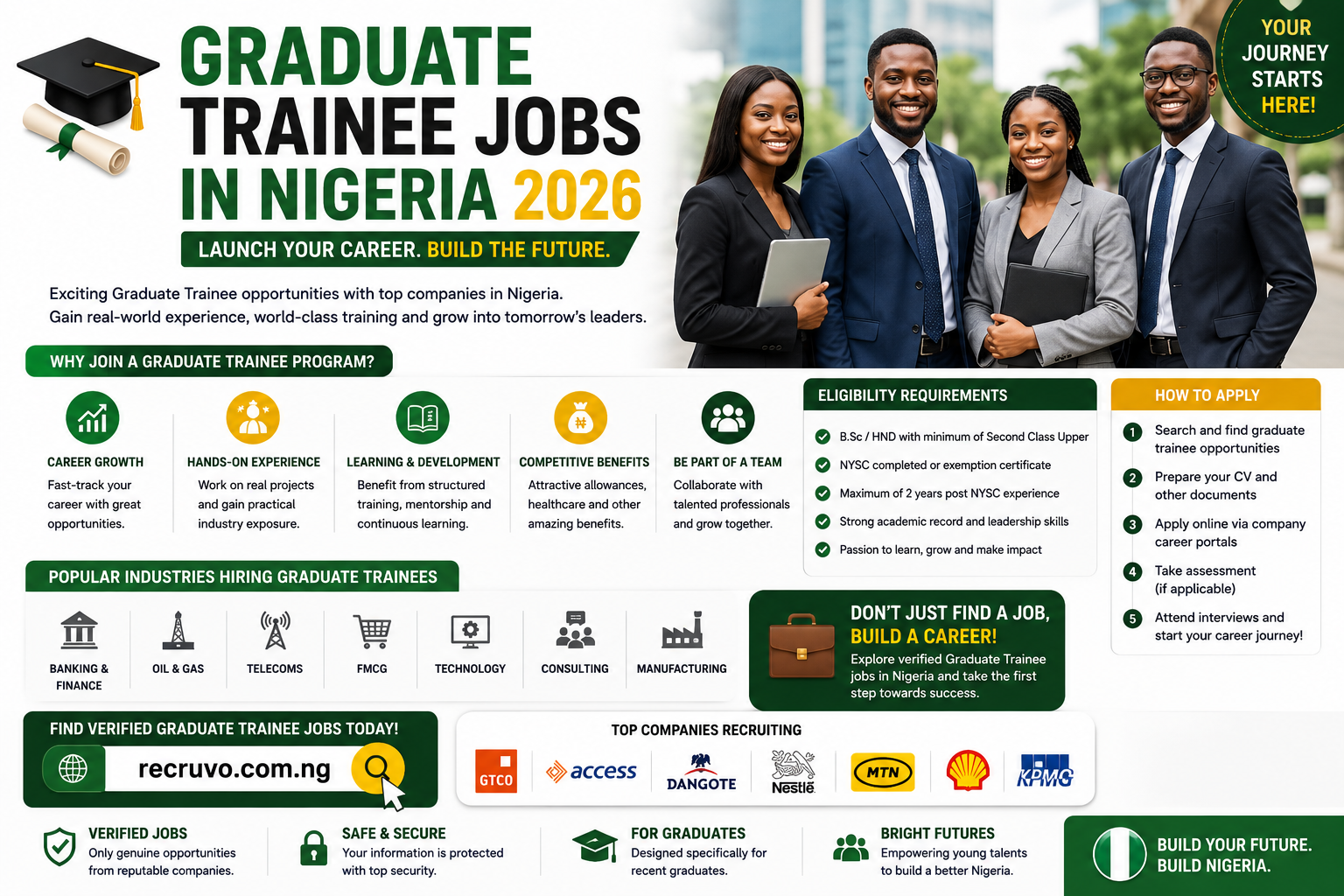
While specific requirements vary by company and sector, most graduate trainee programmes in Nigeria share a common set of eligibility criteria in 2026. These include:
- Educational Qualification: A minimum of a Bachelor’s degree (B.Sc. or B.Tech) or Higher National Diploma (HND) from an accredited Nigerian or foreign university. Most competitive programmes require a minimum of Second Class Upper (2:1), though some accept Second Class Lower (2:2).
- NYSC Completion: Virtually all graduate trainee programmes require a completed NYSC discharge certificate or a valid NYSC exemption certificate. Some companies allow current corps members to apply if they will complete service before the programme’s resumption date.
- Age Limit: Banking and consulting firms typically cap applicants at 26 years. Oil and gas companies are slightly more flexible, often accepting candidates up to 28 years. Technology companies tend to be less rigid about age, focusing more on skills and aptitude.
- O’Level Requirements: A minimum of five credits in WAEC or NECO, typically including English Language and Mathematics, is standard across industries.
- Post-NYSC Experience: Most programmes require a maximum of one to two years of post-NYSC work experience. Fresh graduates with no experience are equally encouraged to apply.
- Skills: Strong communication skills, analytical ability, digital literacy, and a willingness to learn and adapt in a fast-paced environment are expected across all sectors.
Top Sectors Offering Graduate Trainee Jobs in Nigeria 2026
1. Banking and Financial Services
The banking sector remains one of the most active recruiters of graduate trainees in Nigeria, year after year.
Nigerian banks run some of the most structured and well-resourced training programmes in the country, and landing a spot at a top-tier bank after NYSC is widely regarded as one of the best career starts available to a young Nigerian professional.
Access Bank’s Entry Level Talent Programme (ELTP) is one of the most reputable graduate trainee programmes in Nigeria. It begins with an intensive training school covering corporate finance, customer service, digital banking, and compliance. Trainees are subsequently deployed across departments, where their performance is monitored closely for promotion decisions. The programme opens in both Q1 and Q3 annually. Guaranty Trust Bank (GTBank), Zenith Bank, Stanbic IBTC, United Bank for Africa (UBA), and First Bank of Nigeria also run structured graduate trainee programmes with competitive offerings.
Banking trainees in Nigeria typically earn between ₦180,000 and ₦350,000 per month, depending on the institution. Major banks also offer health insurance, performance bonuses, and staff loan facilities as part of the overall package.
2. Oil and Gas
Oil and gas is the highest-paying sector for graduate trainees in Nigeria. Companies like Shell, Chevron, TotalEnergies, Nigerian LNG Limited (NLNG), and the Dangote Petroleum Refinery offer graduate trainee packages that can exceed ₦500,000 to ₦800,000 per month, plus accommodation allowances, transport, and health benefits. These programmes are also the most competitive, with thousands of applicants vying for a handful of positions each cycle.
The Dangote Refinery Graduate Trainee Program 2026 is officially open and is designed to attract talented graduates into engineering, operations, and administration. Selected trainees receive hands-on training, mentorship, and direct exposure to one of the largest refinery projects in Africa. NLNG’s graduate trainee recruitment is equally prestigious, offering placements in technical and commercial operations at its Bonny Island facilities.
Oil and gas programmes typically require degrees in Engineering, Geosciences, Chemistry, or related STEM fields. Some commercial and administrative roles accept Business Administration, Accounting, and Economics graduates. Age limits are generally more relaxed in this sector, often extending to 28 years.
3. Fast-Moving Consumer Goods (FMCG)
FMCG companies offer some of the most globally recognised graduate trainee programmes in Nigeria, particularly for those interested in brand management, supply chain, commercial sales, and manufacturing. The Nigerian Breweries Global Graduate Program 2026, backed by the HEINEKEN global network, is one of the most prestigious. It is designed to identify and fast-track exceptional graduates into future industry leadership roles in the energy, beverages, and consumer goods space, and includes international assignment opportunities.
Nestlé Nigeria’s graduate trainee programme exposes young professionals to the company’s international Learning and Development roadmap, with participants working on real improvement projects and receiving mentorship from senior managers. Trainees in this programme earn between ₦180,000 and ₦220,000 monthly, plus housing and canteen allowances. Unilever, Procter & Gamble (P&G), and BAGCO (a division of Flour Mills of Nigeria Plc) also run active 2026 graduate trainee programmes that target candidates under 28 years with strong academic records in business, engineering, or sciences.
Applications for FMCG programmes typically open between May and August, and NYSC completion is a firm requirement.
4. Consulting and Professional Services
The Big Four accounting and consulting firms, PwC, Deloitte, KPMG, and EY, all operate structured graduate trainee programmes in Nigeria that are widely regarded as excellent launchpads for careers in audit, tax, advisory, and management consulting. PwC Nigeria’s Graduate Trainee Programme 2026 is open to graduates from different degree paths and backgrounds, requiring a minimum of Second Class Lower (2:2) and five O’Level credits. The programme emphasises professional development through access to a global network of over 364,000 colleagues across 136 countries.
KPMG Nigeria’s Graduate Trainee Programme for 2027 (with training school resumption in September 2026) follows a six-stage selection process: application, data validation, aptitude test, assessment centre, partner interview, and offer. The firm encourages applicants to research which business area, audit, tax, or advisory, aligns best with their qualification and interests before applying.
Consulting trainees are expected to bring strong analytical thinking, problem-solving ability, and communication skills. Degrees in Accounting, Finance, Economics, Law, and Engineering are most commonly represented in these cohorts.
5. Telecommunications
MTN Nigeria’s Global Graduate Development Program is a 12-month programme designed to produce future technology and business leaders within the MTN ecosystem. Trainees earn between ₦180,000 and ₦220,000 monthly, plus bonuses and benefits, with rotational postings across Lagos and other regions of Nigeria. The programme focuses on sales, marketing, IT, engineering, and corporate strategy.
Airtel Nigeria and Ericsson Nigeria also recruit graduate trainees in telecommunications and cloud infrastructure roles, particularly targeting graduates with degrees in Computer Engineering, Telecommunications Engineering, and Computer Science.
6. Technology and Fintech
Nigeria’s rapidly growing technology ecosystem has opened a new and exciting tier of graduate trainee opportunities. Companies like Interswitch, Flutterwave, Paystack, and a growing number of funded startups now offer structured graduate programmes that focus on software engineering, data analytics, product management, and cybersecurity. Technology graduate trainees are among the highest-paid in the private sector, earning between ₦200,000 and ₦500,000 monthly, with additional perks such as remote work options and equity participation in some startups.
Unlike banking and FMCG, tech companies tend to be more flexible on age requirements, focusing instead on demonstrated skills, GitHub portfolios, certifications, and practical ability. Graduates with degrees in Computer Science, Information Technology, and Engineering are highly sought after, but self-taught developers and data analysts with strong portfolios have also been successful in these programmes.
How the Graduate Trainee Selection Process Works
Most top Nigerian employers, including GTBank, Shell, Unilever, MTN, and Access Bank, follow a structured, multi-stage selection process. Understanding each stage helps you prepare strategically and avoid being eliminated early.
Stage 1: Online Application
The process begins with an online application on the company’s careers portal. You will typically upload your CV, a cover letter, and supporting documents such as your degree certificate, NYSC discharge certificate, and O’Level results. Accuracy is critical, false information is grounds for immediate disqualification at any stage of the process.
Stage 2: Aptitude Tests
Shortlisted candidates are invited to complete online aptitude tests covering verbal reasoning, numerical reasoning, logical reasoning, and sometimes personality assessments. These tests are timed and competitive. Practicing past aptitude test questions specific to each company’s format significantly improves your performance.
Stage 3: Assessment Centre
Candidates who pass the aptitude tests are typically invited to an assessment centre, where they participate in group exercises, case study presentations, in-tray exercises, and business simulations. This stage evaluates your ability to work under pressure, collaborate in a team, communicate clearly, and make business decisions with limited information.
Stage 4: Panel or HR Interview
Successful assessment centre candidates proceed to one or more rounds of interviews, first with HR, and then with senior management or a partner-level panel. These interviews assess your motivation, cultural fit, knowledge of the company and industry, and your career goals. Research the company’s history, values, recent news, and strategic direction thoroughly before this stage.
Stage 5: Offer and Resumption
Successful candidates receive a formal job offer and are given a resumption date for training school or onboarding. Medical screening is often required before final resumption.
Where to Find Graduate Trainee Jobs in Nigeria 2026
Finding the right opportunities requires using the right platforms consistently. The most reliable sources for graduate trainee job listings in Nigeria include:
- Company Career Portals: Always apply directly through the official careers page of each company. Fraudulent recruitment scams are widespread, legitimate companies never charge application fees.
- MyJobMag (myjobmag.com): One of Nigeria’s most active job boards, with dedicated filters for graduate trainee programmes updated daily.
- HotNigerianJobs (hotnigerianjobs.com): Currently listing over 280 active graduate trainee openings across Nigeria as of June 2026.
- LinkedIn: Follow the company pages of your target employers and turn on job alerts. Many Nigerian companies now post trainee openings exclusively on LinkedIn before broader distribution.
- Jobberman and Glassdoor Nigeria: Both platforms aggregate listings and include salary estimates and employee reviews to help you evaluate opportunities.
Graduate Trainee Salaries in Nigeria 2026: What to Expect
Salary is one of the most important factors in evaluating a graduate trainee opportunity. In 2026, the average graduate trainee salary in Nigeria ranges from ₦100,000 to ₦250,000 monthly, with a median around ₦150,000. However, salaries vary significantly across sectors:
- Oil and Gas: ₦400,000 – ₦800,000+ monthly (Shell, Chevron, TotalEnergies, NLNG)
- Technology and Fintech: ₦200,000 – ₦500,000 monthly (Flutterwave, Paystack, Interswitch)
- Banking: ₦180,000 – ₦350,000 monthly (Stanbic IBTC, GTBank, Access Bank)
- FMCG: ₦180,000 – ₦220,000 monthly + housing and transport allowances (Nestlé, Nigerian Breweries)
- Consulting: ₦150,000 – ₦250,000 monthly (PwC, KPMG, Deloitte, EY)
- Manufacturing: ₦130,000 – ₦160,000 + accommodation (Dangote Group)
Beyond base pay, many employers supplement graduate trainee packages with health insurance, pension contributions, transportation allowances, canteen or meal subsidies, and performance bonuses. When evaluating an offer, always consider the total compensation package and the quality of the training and career development opportunities, not just the monthly take-home figure.
Tips to Stand Out and Get Hired as a Graduate Trainee in Nigeria
Given the intense competition, thousands of applications per opening, standing out requires deliberate preparation well before application deadlines arrive.
Tailor your CV to every role. A generic CV sent to every company is one of the most common mistakes applicants make. Recruiters at top firms notice immediately when a CV has not been customised. Highlight skills and experiences that align specifically with the sector and function you are applying for.
Invest in high-demand digital skills. Candidates who demonstrate proficiency in data analysis tools (Excel, SQL, Python), financial modelling, digital marketing, or project management consistently command higher offers and stand out in competitive pools. Online certifications from platforms like Coursera, LinkedIn Learning, and Google are widely recognised by Nigerian employers.
Practice aptitude tests. Most candidates underperform in aptitude tests not because they lack intelligence but because they are unfamiliar with the format and time pressure. Practise regularly using past questions specific to the companies you are targeting.
Research your target companies thoroughly. Knowing a company’s recent business performance, strategic direction, key competitors, and corporate values will distinguish you during interviews. Candidates who demonstrate genuine interest and industry awareness make a lasting impression on panels.
Apply early and apply often. Many graduate trainee programmes close their applications weeks before the published deadline once the applicant pool reaches capacity. Submit your application as early as possible after a programme opens, and target multiple companies simultaneously to maximise your chances.
Final Thoughts: Your Corporate Career Starts Here
The Nigerian job market is challenging, and competition for graduate trainee positions is real. But with the right preparation, strategic targeting, and consistent effort, a rewarding corporate career is entirely within reach. In 2026, companies across banking, oil and gas, FMCG, technology, consulting, and telecommunications are actively looking for brilliant, motivated young Nigerians to join their teams and grow into the leaders of tomorrow. Your degree got you to the starting line, now it is your preparation, your skills, and your persistence that will get you across it. Start your search today, apply strategically, and position yourself for the career you have worked hard to earn.