
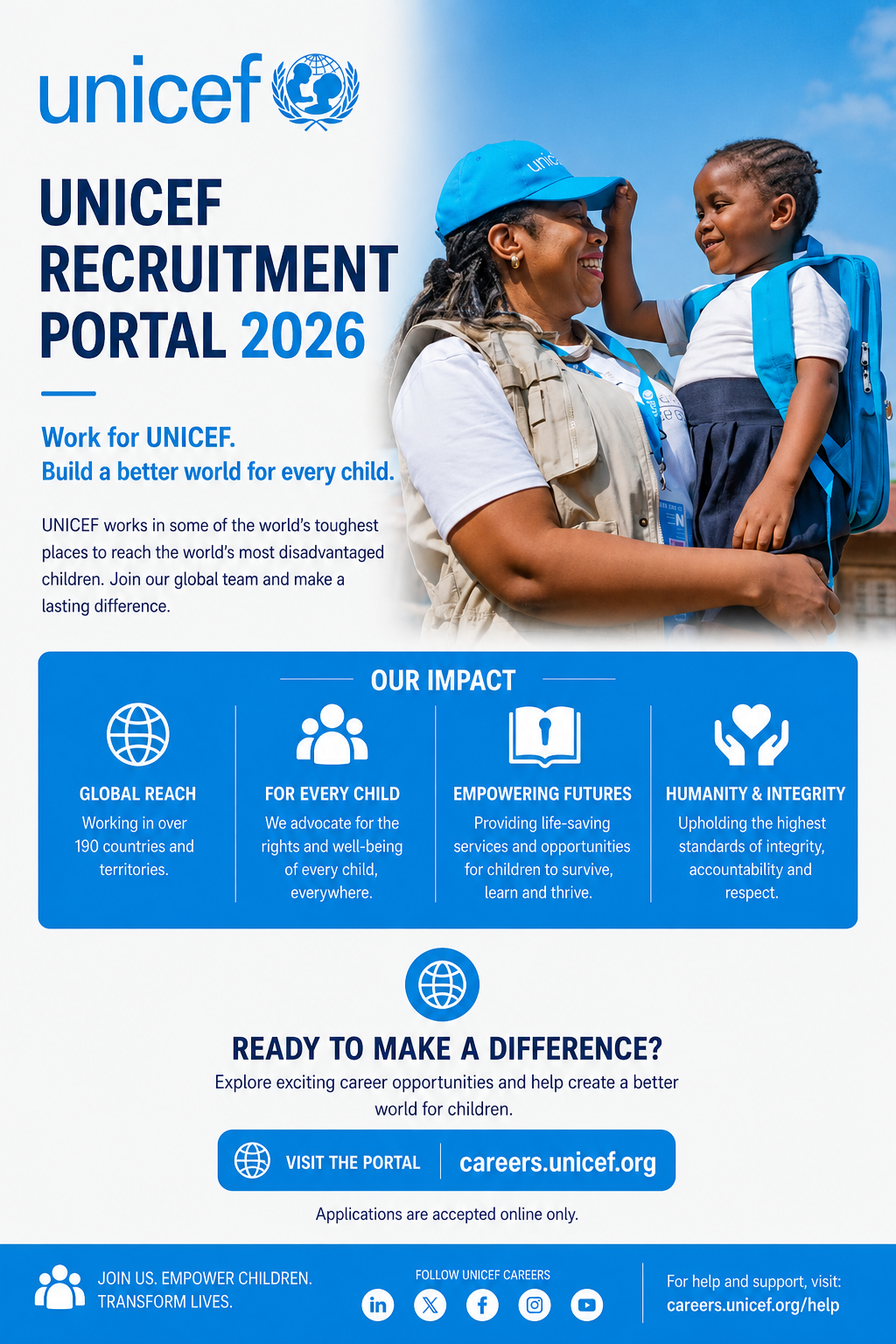
UNICEF Recruitment Portal is the official online platform where UNICEF advertises all its vacancies and receives job applications from candidates across the globe.
The portal is hosted at unicef.org/careers and is powered by Workday, a modern human resources management system.
Separate profiles are required for staff positions and consultant positions, so candidates are encouraged to set up and maintain their Workday career profile well before any application deadline.
As of June 2026, there are over 200 active UNICEF vacancies open worldwide, spanning diverse functional areas including child protection, education, health, nutrition, water sanitation and hygiene (WASH), social policy, supply chain, communications, finance, and emergency response.
Whether you are a fresh graduate looking for an internship or a seasoned professional seeking a senior leadership role, the portal caters to a wide range of talent levels and backgrounds.
UNICEF Job Categories in 2026
Understanding UNICEF’s job structure is crucial before you begin your search on the recruitment portal. The organization offers four broad categories of employment, each with distinct eligibility requirements and benefits.
1. International Professional (IP) Staff
International Professional staff are recruited globally and serve at UNICEF duty stations around the world. These professionals occupy leadership, managerial, and specialist roles that demand a high level of technical expertise. Senior and Director-level appointments also fall within this category. To qualify as an International Professional, candidates are normally required to hold an advanced university degree in a field relevant to UNICEF’s mandate, though extensive qualifying work experience may be considered in some cases.
Within the IP category, grades and minimum experience requirements are structured as follows:
- P-1: One year of relevant professional experience
- P-2: Two years of relevant professional experience
- P-3: Five years of relevant professional experience
- P-4: Eight years of relevant professional experience
- P-5 and Director Levels: Senior leadership positions requiring over a decade of proven experience
Estimated base salaries for IP roles range from approximately $50,000 to over $99,000 USD annually at grades P-2 through P-4, before additional UN entitlements and allowances are factored in.
2. National Officer (NO) Staff
National Officers are nationals of the country in which they serve, and they bring invaluable local knowledge, language skills, and contextual understanding of the country’s institutions. National Officer positions are issued fixed-term or temporary appointments and come with competitive salaries and benefits. The grades within this category range from NO-A through NO-D, with NO-D representing the highest salary level.
3. General Service (GS) Staff
General Service staff are locally recruited and provide essential administrative and support services across UNICEF offices globally, from headquarters to field duty stations. Entry into the General Service category requires at minimum a completed secondary education, while a first-level university degree is considered an asset. GS grades range from G-1 (entry level) through G-7 (senior support level), with G-7 representing the highest salary within the category.
4. Consultants, UN Volunteers, and Interns
Beyond the three main staff categories, UNICEF also engages Individual Contractors, Consultants, United Nations Volunteers (UNV), and Interns. These roles offer flexible, time-bound engagements and are ideal for professionals and students who want to contribute to UNICEF’s mission without committing to a full staff appointment. UNICEF has progressively moved toward offering monthly stipends for interns at many duty stations, though candidates are always advised to check the specific vacancy for compensation details.
Contract Types at UNICEF
UNICEF’s three main staff categories offer two primary contract types: Fixed-Term Appointments (FTA) and Temporary Appointments (TA). Both FTA and TA staff receive the same base salaries in accordance with the salary scale of their respective staff category.
However, TA staff receive slightly reduced benefits compared to their FTA counterparts. Importantly, once the maximum cumulative contract duration of 46 months under a temporary appointment has been reached, a mandatory 12-month break must be observed before the staff member can be re-engaged under another TA.
UNICEF heavily leverages temporary appointments and consultancies alongside fixed-term contracts, particularly in its emergency and supply chain operations. This means that even time-limited or project-based roles often serve as a practical entry point into the broader UN system.
Key Sectors Hiring in 2026
The UNICEF Recruitment Portal in 2026 reflects the organization’s operational priorities across the globe. The major hiring areas for the current cycle include:
- Child Protection: Safeguarding children from abuse, exploitation, trafficking, and violence
- Education: Expanding access to quality learning, especially in conflict-affected regions
- Health and Nutrition: Supporting immunization drives, maternal health, and food security programs
- WASH (Water, Sanitation & Hygiene): Delivering clean water and improved sanitation to vulnerable communities
- Social Policy: Designing and advocating for child-sensitive social protection systems
- Supply Chain: Managing procurement and logistics, including through UNICEF’s Supply Division in Copenhagen, which is the world’s largest buyer of vaccines
- Communication & Advocacy: Driving public engagement and fundraising on behalf of children
- Finance and Administration: Ensuring sound financial management and accountability
Eligibility Requirements for UNICEF Jobs 2026
Eligibility requirements vary by role and grade level, but several standards apply across the board when using the UNICEF Recruitment Portal in 2026:
- Education: International Professional roles require an advanced university degree. General Service roles require secondary school completion. All degrees must come from accredited (bona fide) academic institutions, as UNICEF will only accept degrees that satisfy the required education level from recognized universities.
- Experience: Relevant professional work experience is mandatory for all roles and scales with the grade level being applied for.
- Language: Fluency in English is required for most positions. Knowledge of a second UN language (French, Spanish, Arabic, Chinese, or Russian) is frequently an asset or mandatory requirement depending on the duty station.
- Nationality: National Officer positions require citizenship of the duty station country. International Professional roles are open to nationals of UNICEF member states. UNICEF emphasizes equity, diversity, and geographic balance in its hiring decisions.
- Mobility: Applicants for International Professional positions must be open and willing to work outside their country of residence and rotate between duty stations as required.
How to Apply on the UNICEF Recruitment Portal 2026: Step-by-Step
The application process through the UNICEF Workday-powered recruitment portal is straightforward once you know the steps. Here is a detailed walkthrough:
Step 1: Create or Update Your Career Profile
Navigate to unicef.org/careers and either create a new Workday account or log in to your existing one. Complete your career profile comprehensively, covering your education history, work experience, language proficiency, and key skills. Your profile serves as the baseline application document that hiring managers review, so accuracy and completeness are critical. Group your work duties into categories or areas of responsibility rather than a long bulleted list, which makes the profile more reader-friendly and impactful.
Step 2: Search and Filter Available Vacancies
Use the built-in search and filter functions on the portal to identify relevant opportunities. You can filter by region or country (duty station), job family (e.g., Programme and Policy, Supply, Communication, Finance), contract type, and grade level. Read each job description carefully, paying close attention to the minimum educational and experience requirements, before deciding to apply.
Step 3: Prepare a Targeted Cover Letter
For most roles, a cover letter is a required component of your application. Avoid recycling generic letters. Instead, craft a focused, one-page letter that clearly explains why this specific role appeals to you, how your background aligns with the job requirements, and why UNICEF’s mission resonates with you personally. It is strongly advisable to draft your cover letter in a separate word processing document first, as the portal’s system may time out after prolonged inactivity.
Step 4: Submit Your Application
Once your profile is complete and your cover letter is finalized, submit your application before the stated deadline. Be mindful of time zone differences, as deadlines are typically listed in Coordinated Universal Time (UTC). After a successful submission, you will receive an automated confirmation email from the system. Remember: UNICEF does not charge any fee at any stage of the recruitment process, including application, interview, travel, processing, or training. If you encounter any solicitation of payment, treat it as a scam and report it immediately.
Step 5: Assessments and Interviews
Shortlisted candidates typically undergo a written technical assessment followed by a competency-based panel interview. Interview panels at UNICEF commonly consist of three to five panelists. UNICEF follows the STAR format for competency-based interviews, meaning you should be prepared to describe specific Situations, Tasks, Actions, and Results from your past professional experience. Reference checks and other verification processes are conducted for candidates at advanced stages of the selection process.
UNICEF Recruitment Timeline in 2026
Patience is key when applying to UNICEF. The full recruitment process, from the application close date to receiving a formal job offer, commonly takes between two and four months. Some urgent or emergency positions may move significantly faster, while roster-based recruitment processes, where candidates are pre-vetted for a pool of future vacancies, can take considerably longer. Candidates are encouraged to keep their profiles updated on the portal and to set up job alert notifications to be informed of new openings that match their search criteria.
Benefits and Compensation for UNICEF Staff in 2026
UNICEF offers a highly competitive remuneration package in accordance with United Nations-wide salary scales as administered by the International Civil Service Commission (ICSC). Beyond base salary, staff members are entitled to a comprehensive range of benefits that include:
- Tax Exemption: Salaries, grants, and allowances paid by the United Nations are generally exempt from national income tax.
- Family Allowances: Staff with eligible dependent children may receive dependency grants.
- Annual Leave: Depending on the contract type, staff are entitled to 18 to 30 days of paid vacation per year, in addition to 10 paid public holidays annually (which vary by field office).
- Health Insurance: All eligible staff can participate in one of UNICEF-sponsored medical insurance plans.
- Paid Special Leave: Maternity, paternity, adoption leave, and paid sick leave are provided in accordance with UN policy.
- Rental Subsidy and Hazard Pay: Staff assigned to hardship or non-family duty stations receive additional entitlements to compensate for difficult living conditions.
- Learning and Development: Access to UNICEF’s global learning hub, Agora, provides continuous professional development resources.
Tips for a Successful UNICEF Job Application in 2026
The competition for UNICEF roles is intense. Here are practical strategies to strengthen your application:
- Align your profile with the job description: Tailor the language and emphasis of your career profile to mirror the terminology and priorities outlined in each specific vacancy announcement.
- Quantify your achievements: Whenever possible, back your accomplishments with data and specific results rather than vague statements of responsibility.
- Demonstrate UNICEF’s core values: UNICEF’s values of Care, Respect, Integrity, Trust, Accountability, and Sustainability (CRITAS) are central to the organization’s culture. Incorporate examples that reflect these values throughout your application materials.
- Prepare for STAR-format interviews: Practice structuring your answers around Situation, Task, Action, and Result before your panel interview.
- Set up job alerts: The portal allows candidates to register for email notifications when new positions matching their profile are posted, ensuring you never miss an opportunity.
- Apply early: Do not wait until the deadline. Submitting your application early reduces the risk of technical issues and demonstrates proactiveness.
Beware of Recruitment Scams
Given UNICEF’s global profile, fraudulent recruitment schemes that impersonate UNICEF are unfortunately common. It is important to remember that UNICEF never charges a fee at any stage of the recruitment process, whether for application, interview, travel, processing, or training, and it does not request banking information from applicants. All legitimate correspondence from UNICEF will originate from official UNICEF domain email addresses. Always verify vacancies directly through the official portal at unicef.org/careers before submitting any personal information.
Final Thoughts
A career with UNICEF is more than a job, it is a calling to stand up for every child, in every corner of the world.
The UNICEF Recruitment Portal 2026 is the definitive starting point for professionals who want to contribute to transformational work in child protection, education, health, nutrition, emergency response, and beyond.
With over 200 active vacancies currently listed across 190 countries, and a Workday-powered portal that streamlines the application experience, the opportunity to join one of the United Nations’ most respected agencies has never been more accessible.
Start by building a strong, complete career profile at unicef.org/careers, tailor each application to the specific role, and prepare thoroughly for each stage of the selection process. The children whose lives depend on UNICEF’s work are worth every effort it takes to be part of this mission.