
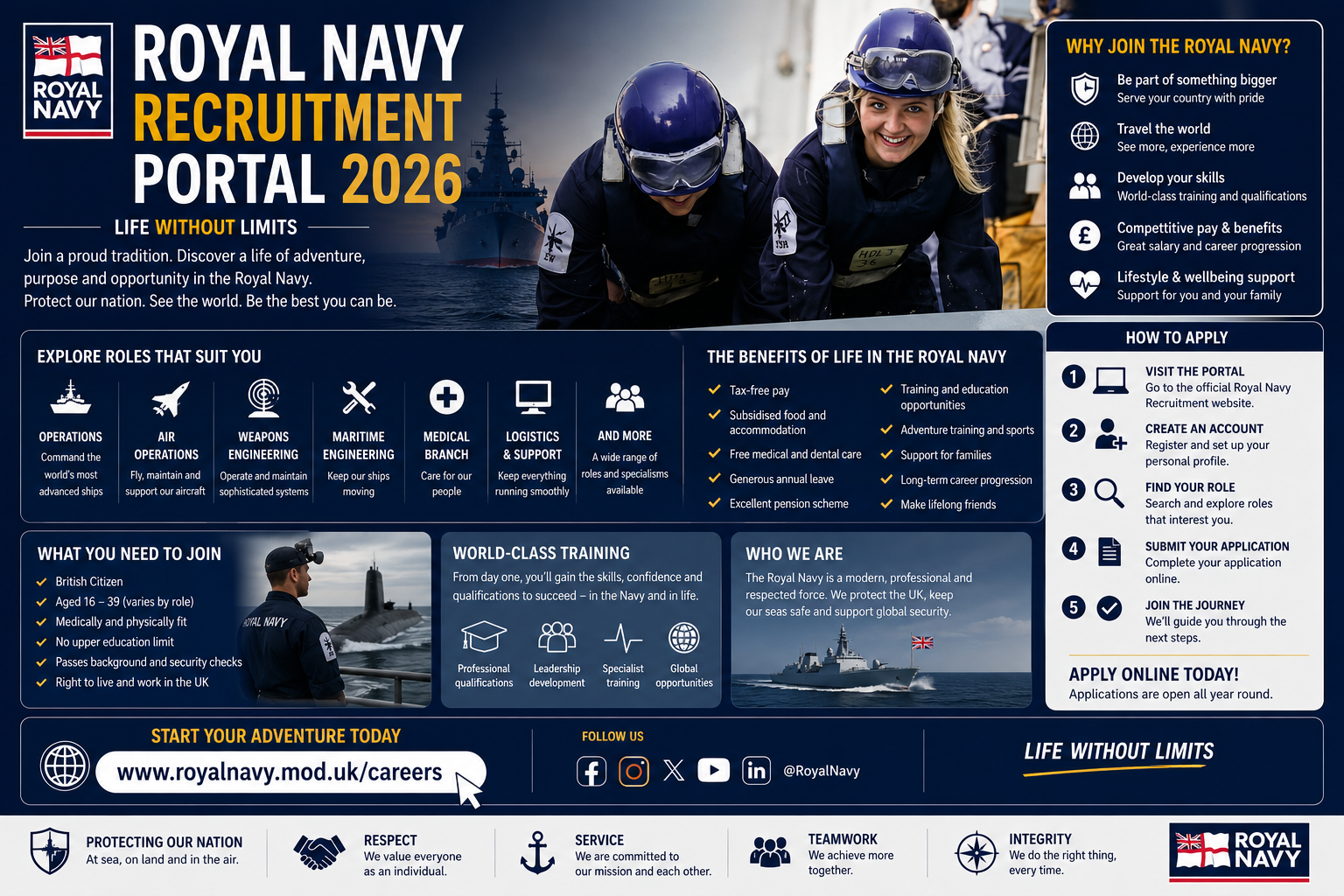
Royal Navy is the United Kingdom’s principal naval warfare service and one of the most technologically sophisticated naval forces in the world.
With a history stretching back centuries, the Royal Navy continues to project British power and protect national interests across the globe, from the North Atlantic and the Arctic to the Indo-Pacific, Caribbean, Mediterranean, and beyond.
Its fleet includes nuclear-powered submarines, the twin Queen Elizabeth-class aircraft carriers (HMS Queen Elizabeth and HMS Prince of Wales), Type 45 destroyers, Type 23 frigates, amphibious assault ships, and a vast array of supporting vessels and aircraft.
Today’s Royal Navy combines traditional seamanship and combat capability with deep expertise in cyber security, artificial intelligence, nuclear propulsion, aviation, intelligence gathering, and global humanitarian response. Joining the Royal Navy in 2026 means becoming part of a force that is simultaneously steeped in history and at the forefront of 21st-century defence technology.
Royal Navy Recruitment Portal: The Official Application Gateway
All Royal Navy recruitment in 2026 begins through the official careers portal at www.royalnavy.mod.uk/careers. This is the authoritative platform where prospective recruits can explore available roles using the Role Finder tool, register their interest, submit their online application form, and track their progress through the selection process.
The portal also features a 24-hour virtual recruiter chatbot available around the clock to answer questions about roles, eligibility, and the joining process, making it easy to get guidance at any time of day or night. For those who prefer speaking to a person, the Royal Navy recruitment team can be reached by phone on 0345 607 5555, Monday to Friday 9:00 AM to 5:30 PM, and Saturday 10:00 AM to 4:00 PM.
Separate contact lines exist for specialist recruitment streams:
- Royal Marines: 0345 600 1444
- Royal Fleet Auxiliary (RFA): 0345 604 0520
- Royal Naval Reserves: 0345 600 3222
Who Can Join the Royal Navy in 2026? Full Eligibility Requirements
The Royal Navy sets clear eligibility criteria that all applicants must meet before their application can proceed. Here is a full breakdown of the core requirements:
Nationality
You can join the Royal Navy if you are:
- A national of the United Kingdom or the Republic of Ireland
- A Commonwealth citizen: applying from inside your country of origin (minimum age 18), or as a resident of the UK (minimum age 16)
- A dual British national who is not required to complete National Service (written evidence may be required)
It is important to note that some roles carry stricter nationality and residency requirements due to security classification. Applicants must hold a current valid passport, and Commonwealth citizens residing outside the UK must ensure their permission to enter and remain in the UK covers the entirety of the recruitment process through to entry. Candidates should never travel to the UK unless directed to do so by the Royal Navy Overseas Team.
Age Requirements
- General entry (Ratings): Applications can begin from 15 years and 9 months, but applicants must be at least 16 years old on the day of entry into basic training. The upper age limit for most roles is 39 years.
- Officer entry: Generally between 18 and 42 years old, depending on the role.
- Applicants under 18 require the formal written consent of a parent or guardian.
- The Royal Fleet Auxiliary (RFA) has no stated upper age limit, applicants need only be 17 years and six months to apply, and 18 to begin employment.
Physical and Medical Standards
Applicants must meet the Royal Navy’s physical fitness, eyesight, and hearing standards. Key physical benchmarks include:
- Minimum height: 145 cm for general entry; 151.5 cm for Aviators; 157 cm for Submariners
- Successful completion of the Pre-Joining Fitness Test (PJFT): a 2.4 km timed run
- A satisfactory medical examination to confirm fitness for naval service
Educational Qualifications
- Ratings (non-officer roles): Many roles require no formal qualifications. However, GCSEs in English, Maths, and Science (or equivalent) significantly broaden the range of roles available to you.
- Officer entry: A minimum of 72 UCAS points and five GCSEs at Grade 4/C or above (including English and Maths) are typically required. Some specialist officer roles require higher academic qualifications or specific degrees.
Character and Criminal Record
Candidates must be of good character. If you have a previous criminal conviction, you may still be eligible to join the Royal Navy depending on the nature of the offence and type of sentence. However, certain convictions will permanently bar entry or re-entry. All applicants undergo a thorough security check and background verification as a mandatory part of the selection process.
Royal Navy Career Pathways in 2026: Finding Your Profession
The Royal Navy organises its roles around broad Professions, each containing multiple specific jobs. In 2026, recruitment is particularly focused on technical and specialist disciplines, with the 2026 intake actively open with emphasis on Cyber Security, Engineering, and Submarine Services. Here is an overview of the main career pathways:
Ratings (Enlisted Roles)
There are around 60 Rating roles across six main branches, offering entry points for candidates at virtually every education level:
- Warfare: Operating ship systems, navigation, communications, meteorology, and intelligence. This is the largest branch and includes roles such as Warfare Specialist, Hydrographic, Meteorological and Oceanographic Specialist, and Communications Information Systems Specialist.
- Engineering: Maintaining and operating the mechanical and electrical systems of ships, submarines, aircraft, and weapons. Includes roles such as Weapons Engineer, Marine Engineer, and Air Engineering Technician.
- Healthcare and Medical: Delivering healthcare to naval personnel at sea and ashore as a Medical Assistant, Dental Surgery Assistant, or Naval Nurse.
- Aviation (Fleet Air Arm): Supporting the Royal Navy’s aircraft operations as an Aircraft Handler, Air Traffic Controller, or Aircraft Engineering Technician aboard carriers and shore establishments.
- Submarine Service: Operating aboard the Royal Navy’s nuclear-powered attack and ballistic missile submarines, one of the most demanding and well-compensated specialisms in the entire force.
- Logistics and Support: Supply chain management, catering, administration, and other vital support functions that keep the fleet operational.
Officers
Officer roles provide strategic leadership across the same broad disciplines. Whether as a Warfare Officer, Engineering Officer, Logistics Officer, Medical Officer, Chaplain, or specialist in Cyber and Information Warfare, officers command teams and make decisions in high-pressure environments. Pilots entering the Fleet Air Arm begin their careers on a salary of approximately £34,676 from day one of officer training.
Royal Marines
The Royal Marines Commandos are the Royal Navy’s elite amphibious fighting force and wear the legendary green beret. The Royal Marines Commando role is currently offered as an HM Forces Serviceperson Apprenticeship, with a 2026 cohort start date of June 2026 and 558 positions available. Starting pay is £20,400 per year, with substantial additional benefits. The Royal Marines joining process differs from the standard Royal Navy process and involves specialist physical and psychological assessments.
Royal Fleet Auxiliary (RFA)
The Royal Fleet Auxiliary is a civilian-crewed fleet that replenishes and supports Royal Navy ships at sea. RFA careers offer a unique “4 months on, 3 months off” schedule, making it one of the most sought-after work-life balance arrangements in the maritime world. RFA applicants follow a separate joining process and must obtain an ENG1 medical certificate confirming fitness for worldwide sea service.
Royal Naval Reserves
For those who want to serve without leaving their civilian careers, the Royal Naval Reserves allow you to contribute to national defence on a part-time basis while maintaining your existing job and lifestyle.
The Royal Navy Joining Process: Step by Step
The Royal Navy runs a structured, multi-stage selection process designed to ensure every candidate who enters HMS Raleigh is fully prepared for the demands of naval service. Here is exactly how the joining process works in 2026:
Step 1, Register Your Interest. Begin at www.royalnavy.mod.uk/careers. Use the Role Finder tool to identify professions and roles that match your qualifications and interests, then register your interest in your chosen Profession. Once basic eligibility is confirmed, you will be sent an online application form to complete.
Step 2, Defence Aptitude Assessment (DAA). The DAA is a cognitive ability test conducted either at your local Armed Forces Careers Office (AFCO) or online, under timed conditions. It assesses you across six key areas: Verbal Reasoning, Numerical Reasoning, Work Rate, Spatial Reasoning, Electrical Comprehension, and Mechanical Comprehension. All sections must be attempted, and the pass mark varies by role, the more technically demanding the profession, the higher the required score. Practice materials are available on the Royal Navy website to help you prepare.
Step 3, Selection Interview. A formal interview is conducted to confirm your suitability for your chosen Profession and to explore the specific roles available within it. This interview is normally conducted via video over the Shine video platform, using your own device. It also covers the initial stages of your security application. Expect questions about your motivation for joining, your personal values, relevant experience, and your understanding of life in the Royal Navy.
Step 4, Candidate Preparation Course (CPC). The CPC is a four-day residential induction to life in the Royal Navy. It is a pass-or-fail assessment that evaluates your physical fitness and medical eligibility in a realistic naval environment. The CPC gives you a genuine taste of what basic training will feel like and ensures you are physically and medically ready to begin. Preparation is key, arrive fit, well-rested, and mentally prepared.
Step 5, Security Check. All Royal Navy recruits must pass a thorough security vetting process. The depth of the check varies depending on the security classification of your chosen role. This can take several weeks and involves verification of your identity, background, residency history, and any criminal or financial records.
Step 6, Entry to HMS Raleigh. Once you have passed all eligibility criteria and your security check is cleared, you will receive an offer of a place at HMS Raleigh in Torpoint, Cornwall, the Royal Navy’s initial training establishment. All new Royal Navy ratings begin their career here. Allocation to a specific role within your chosen Profession occurs during the latter stages of initial training.
Royal Navy Salary and Benefits 2026: What You Will Earn
In June 2026, the UK Armed Forces’ Pay Review Body recommended an annual salary increase of 3.6% for all armed forces personnel, covering the 2026–2027 pay period. Here is an overview of Royal Navy compensation across different entry levels:
- Ratings (Basic Training): Starting salary of £26,334 (£25,200 for Warfare Ratings during basic training). With promotion and service, experienced Ratings can earn over £64,000 per year.
- Officers: New officers begin as Midshipmen, progressing rapidly with structured pay increases. After one year of service and completion of training, promotion brings salary increases, with further advancement possible after just two and a half years of service. Senior officers and Medical Officers can earn up to £86,058 annually.
- Pilots: Royal Navy pilots start on approximately £34,676 from their first day, reflecting the high responsibility of aviation roles.
Submarine Service Bonuses
The Submarine Service commands some of the most attractive financial packages in the Royal Navy:
- A £5,000 bonus on earning your Dolphins (the qualification badge of a submariner), rising to £7,500 for Warfare Specialist Submariners
- Additional Submarine Pay starting at £6,106 per year and rising to £10,690 with time served
- A £25,000 retention bonus after six years of qualifying submarine service
Benefits Package
Beyond base pay, all Royal Navy personnel receive a comprehensive package that includes:
- Subsidised food and accommodation while at sea, and allowances while ashore
- Free healthcare and dental care
- Six weeks of paid annual leave
- Free gym membership and access to world-class adventurous training
- Subsidised travel
- A defined benefit pension scheme
- Free uniform and professional development training throughout your career
- Access to the UK’s largest apprenticeship provider
Commonwealth Recruitment 2026: Joining from Outside the UK
The Royal Navy’s Commonwealth Recruitment Programme gives eligible citizens of Commonwealth nations the opportunity to build a career in the Royal Navy. Due to consistently high demand, this pathway operates on a monthly opening cycle: applications open on the first Friday of every month at 15:00 GMT and close once the monthly capacity is reached.
Interested applicants must submit an Expression of Interest through the official portal at www.royalnavy.mod.uk/careers/joining-options/commonwealth-and-non-british. Once eligibility is confirmed, candidates then progress through the standard assessment stages: eligibility check, aptitude and knowledge testing, medical and fitness screening, interview, sustainability review, and security and background verification. Successful candidates then receive an offer to join, followed by training commencement instructions.
A critical warning for Commonwealth applicants: do not travel to the UK unless specifically instructed to do so by the Royal Navy’s Overseas Team. Travelling prematurely could jeopardise your application and result in significant personal expense.
Tips for a Successful Royal Navy Application in 2026
Start with the Role Finder. The Royal Navy’s online Role Finder at www.royalnavy.mod.uk/careers is the most effective way to identify roles that genuinely match your qualifications, skills, and interests. Do not apply for a role simply because it sounds exciting, ensure you meet the eligibility requirements and can articulate a genuine motivation for that specific profession.
Prepare Thoroughly for the DAA. The Defence Aptitude Assessment is the most common stage at which candidates struggle. Use the official practice materials on the Royal Navy website to familiarise yourself with the format of all six sections, particularly Electrical and Mechanical Comprehension, which many candidates find the most challenging. Consistent daily practice in the weeks before your test can significantly improve your performance.
Get Fit Before You Apply. The Pre-Joining Fitness Test and the Candidate Preparation Course both require a solid baseline of physical fitness. Start training well in advance, with a particular focus on aerobic endurance and the 2.4 km timed run. The Royal Navy’s own fitness guidance materials are available on its website and provide clear target times by age and gender.
Be Honest Throughout the Process. The security vetting process is thorough. Any discrepancy between what you declare and what the background check reveals can result in permanent disqualification. If you have a criminal record, declare it honestly and let the Royal Navy assess your case, concealment will always be worse than transparency.
Final Thoughts: Join the Royal Navy in 2026
The Royal Navy Recruitment Portal 2026 is your gateway to one of the most extraordinary careers available anywhere in the world. With the 2026 intake actively open, a 3.6% salary increase confirmed for 2026–2027, some of the most compelling financial packages in the UK’s public sector, especially in the Submarine Service, and the genuine opportunity to serve, lead, and grow across dozens of specialist disciplines, there has rarely been a better moment to begin your Royal Navy application. Start your journey today at www.royalnavy.mod.uk/careers and take the first step toward a life of purpose, adventure, and service at sea.